
As Ajmal Kasab is sentenced to death, Tukaram Omble's family is still coming to terms with the loss. Abhishek Mande

How old was Ajmal Kasab when he was recruited into the Lashkar-e-Tayiba to carry out the 26/11 attacks? Going by an interrogation report prepared by the Bangalore Police, Kasab was 16 when he was roped into the LeT.
'True closure will come only when we as a people, as a civilisation, can relax in crowded, public places without fear, when the ugly metal detectors that greet us at the entrance of every single public space goes forever. That is a distant dream, towards realising which Kasab's sentence is but a baby-step.'

An eight-member Pakistani judicial commission team crossed into India from the Wagah border check post in Punjab on Saturday to conduct the much-delayed cross-examination of witnesses in the 2008 Mumbai attacks, which claimed 166 lives.

Tahawwur Hussain Rana, a Pakistan-born Canadian national and close associate of David Coleman Headley, could be extradited to India in connection with the 26/11 Mumbai terror attacks. Rana's travel history in parts of north and south India before the attacks in 2008 is expected to provide crucial leads for the investigation. His extradition would mark the third person to be tried in India for the attacks, after Ajmal Kasab and Zabiuddin Ansari alias Abu Jundal.
The nine targets struck under 'Operation Sindoor', four in Pakistan and five in Pakistan-occupied-Kashmir, were chosen by the IAF after receiving intelligence inputs about terror camps operating under the guise of health centres to evade detection at these sites, officials said on Wednesday.
'26/11 taught us we have to be ready for a direct attack. Today if anyone launches a similar attack we are more than prepared.'
Tahawwur Hussain Rana, a Pakistani-born Canadian national accused of playing a role in the 2008 Mumbai terror attacks, has been extradited from the United States to India. Rana was arrested in the US in 2009 and convicted in 2011 for providing material support to the Lashkar-e-Taiba terror group, which carried out the Mumbai attacks. He had been fighting extradition since 2012, but the US Supreme Court ultimately denied his review petition, paving the way for his transfer to India. Rana will now face trial in India for his alleged role in the attacks, which killed 166 people.

Bharatiya Janata Party President Amit Shah on Wednesday dubbed the Congress, the Samajwadi Party and the Bahujan Samaj Party as "KASAB", adding yet another acronym in the Uttar Pradesh poll campaign, and said development will elude the state till "Kasab is laid to rest".
'Kasab was never given mutton biryani.' 'What I had said was Kasab had asked for mutton biryani to be served in jail.'

Over 100 terrorists, including high-value targets such as Yusuf Azhar, Abdul Malik Rauf and Mudasir Ahmed, were eliminated during Operation Sindoor on May 7, the Indian military said on Sunday.
Mohammad Ajmal Amir Qasab, 21, is a resident of Faridkot, Tehsil, Dipalpur Dist -Ukada, State -Suba Punjab, Pakistan, is a labour by occupation, according to his confession statement.
As Mumbai gears up to commemorate the third anniversary of the 26/ll terror attacks, correspondent Nishi Tiwari finds the family of policeman Tukaram Omble, who nabbed dreaded terrorist Ajmal Kasab even as bullets were pumped into him, bravely trying to cope with the loss -- just as he would have liked it.
'The precision strikes were well planned and excellently executed. The world will be studying this operation.'
Residents of Ajmal Kasab's village in Pakistan, after hearing the news of the execution of the terrorist, have lashed out at India. The impoverished village of Faridkot, the former home of the 25-year-old Kasab, who was the lone terrorist arrested during the 2008 Mumbai attacks, lies in the farming belt of Punjab province. Residents of Faridkot are mostly illiterate farmers and labourers.

"I remember the evil grin on Kasab's face. Armed with an assault rifle, he was walking towards the suburban platform," he said.
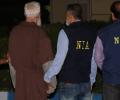
Tahawwur Hussain Rana, a key accused in the 26/11 Mumbai terror attacks, was brought to India on Thursday after being "successfully extradited " from the US, the National Investigation Agency (NIA) said. The 64-year-old Canadian citizen of Pakistani origin landed in Delhi in a special plane on Thursday evening, ending days of speculation of when and how he will be extradited, officials said. The NIA said in a statement that it had secured the successful extradition after years of sustained and concerted efforts to bring to justice the key conspirator behind the 2008 mayhem that claimed 166 lives. Rana is accused of conspiring with David Coleman Headley alias Daood Gilani, and operatives of designated terrorist organisations Lashkar-e-Taiba (LeT) and Harkat-ul-Jihadi Islami (HUJI) along with other Pakistan-based co-conspirators, to carry out the the three-day terror siege of India's financial capital.

Tahawwur Hussain Rana, a Canadian national convicted in the United States for his role in the 2008 Mumbai terror attacks, has been extradited to India. Rana, a close associate of Pakistani-American terrorist David Coleman Headley, was involved in the conspiracy from 2005 onwards and assisted Headley in obtaining a visa for India. He is the third person to be sent on trial in India for the 26/11 attacks after Ajmal Kasab and Zabiuddin Ansari alias Abu Jundal. Rana's extradition comes after US President Donald Trump approved the request.
Kasab's execution is part of the government's effort to demonstrate how it will deal with issues of national security strongly, political journalist Rasheed Kidwai tells Priyanka.
Congress on Saturday said the message of 'zero tolerance' against terrorism has been sent through the execution of Parliament attack convict Afzal Guru, close on the heels of Pakistani terrorist Ajmal Kasab's hanging. Party spokesman Rashid Alvi said, "After Independence, two major acts of terror have taken place in the country -- the attack on Parliament and the Mumbai terror strikes -- and those who were responsible for both have been hanged."
The surprising confession by Kasab on Monday had 'dashed all hopes of the under-trial LeT terrorists in Pakistan who had been in high spirits following Kasab's earlier statement in which he had said he was not guilty, sources in the interior ministry told The News daily.
Zabiuddin Ansari alias Abu Jundal has been spilling the beans about how the entire 26/11 operation was executed from Karachi with the blessings of Lashkar-e-Tayiba founder Hafiz Mohammad Saeed. Rediff.com's Vicky Nanjappa gives details of his ongoing interrogation
Pakistan-based terrorist outfit Tehrik-e-Taliban could target Indian installations near the border areas, said Aditya Mishra, Inspector General (Frontier) of the Border Security Force.

"The real threat to the country comes not from fanatic and extremist Muslims, but from people like Sudheendra Kulkarni," it said in its editorial.

The Mumbai police on Monday submitted a chargesheet before a special court in Mumbai against Pakistani-origin Canadian businessman Tahawwur Rana for his involvement in the November 2008 terror attacks in the metropolis.
With the Supreme Court upholding the death sentence of Ajmal Kasab in the 26/11 Mumbai terror attacks case, Pakistan should now expedite the trial in their court, special public prosecutor Ujjwal Nikam on Wednesday said.
The Bombay high court has rejected the plea of lawyer Abbas Kazmi, who represented terrorist Ajmal Kasab earlier, for initiating contempt action against Judge M L Tahiliyani as he had made certain remarks against the lawyer while dismissing him from the 26/11 attack case.

Maharashtra Governor Ramesh Bais and Chief Minister Eknath Shinde on Sunday paid floral tributes to the martyrs who laid down their lives while fighting terrorists who attacked the metropolis on this day 15 years ago.
An email threatening to target the cave shrine of Vaishno Devi was purportedly sent by the banned terror outfit Lashker-e-Toiba to a hotelier in Katra to avenge the execution of 26/11 terror attack convict Ajmal Kasab, the police said on Monday.
Little wonder, the Human Rights Watch eloquently said in that report cited earlier that "Although prison systems everywhere are marked by inertia, few can match India's in immutability of practice."

Homage has been paid to all those who lost their lives in the 26/11 attacks by the execution of Pakistani terrorist Ajmal Kasab, Special Public Prosecutor Ujjwal Nikam told Rediff.com
The investigation, currently being conducted by the National Investigating Agency, has highlighted the possibility that David Headley -- the American citizen arrested last month in Chicago by the Federal Bureau of Investigation on terror charges -- may have involved a couple of women in his plans.
Pakistani terrorist Ajmal Kasab and his companions were instructed by their Lashkar-e-Tayiba handlers on telephone to hold as many hostages as possible during the 26/11 Mumbai terror attacks to demand from the Indian government the creation of a "separate state for Muslims".
Lawyers defending Lashkar-e-Tayiba commander Zakiur Rehman Lakhvi and six others charged with involvement in the 26/11 Mumbai attacks have said that none of them will go to India as part of a proposed commission to record the testimony of key witnesses, including surviving attacker Ajmal Kasab.
Pakistan government plans to approach an anti-terror court, conducting the trial of seven suspects in the Mumbai attacks, to form a commission that can visit India to record the statements of key witnesses and officials, Interior Minister Rehman has said.
Pakistan's Supreme Court adjourned for two weeks the hearing of Lashkar-e-Tayiba commander Zaki-ur-Rehman Lakhvi's petition seeking his acquittal in a case related to the Mumbai attacks in order to study Ajmal Kasab's confessional statement.
Rejecting Bharatiya Janata Party's demand for a specific anti-terror law, Home Minister P Chidambaram on Thursday said conviction of Ajmal Kasab in Mumbai attack case proved that present laws were adequate to deal with the menace.
Judge ML Tahaliyani, while listing out the reasons why he was not sentencing 26/11 terrorist Ajmal Kasab to life, invoked the Kandahar hijack of December 24, 1999, when the Indian Airlines flight IC-814 was forcibly taken to Afghanistan to secure the release three hardcore terrorists in Kashmir.

Special Public Prosecutor in the 26/11 Mumbai attacks case Ujjwal Nikam on Thursday expressed happiness over awarding of death sentence to Pakistani terrorist Ajmal Kasab for the carnage, saying the verdict has delivered justice to the families of the victims.
Rediff.com correspondent Vicky Nanjappa, who has been following and reporting on the case since the attacks, took up readers' queries about the Ajmal Kasab verdict. Here's the chat transcipt
